


 English
  Romanian
  Portuguese
  Polish
  Italian

In the pursuit of peak performance, racing pigeon fanciers are constantly looking for ways to improve endurance, recovery, and overall condition. Among the supplements that have gained significant popularity in recent years, L-carnitine stands out as one of the most valuable tools for supporting athletic performance. Products such as Top Form from Cest Pharma, which contains 100 mg of L-carnitine, have become an important part of many successful racing programs. However, while the benefits of L-carnitine are undeniable, understanding how to use it correctly is essential for achieving the best results.
L-carnitine plays a crucial role in the body’s energy production system. Its primary function is to transport fatty acids into the mitochondria, often referred to as the powerhouses of the cell, where these fats are converted into usable energy. For racing pigeons, this process is particularly important because long-distance flight relies heavily on fat metabolism. The more efficiently a bird can utilize fat as an energy source, the longer it can maintain its performance during demanding races.
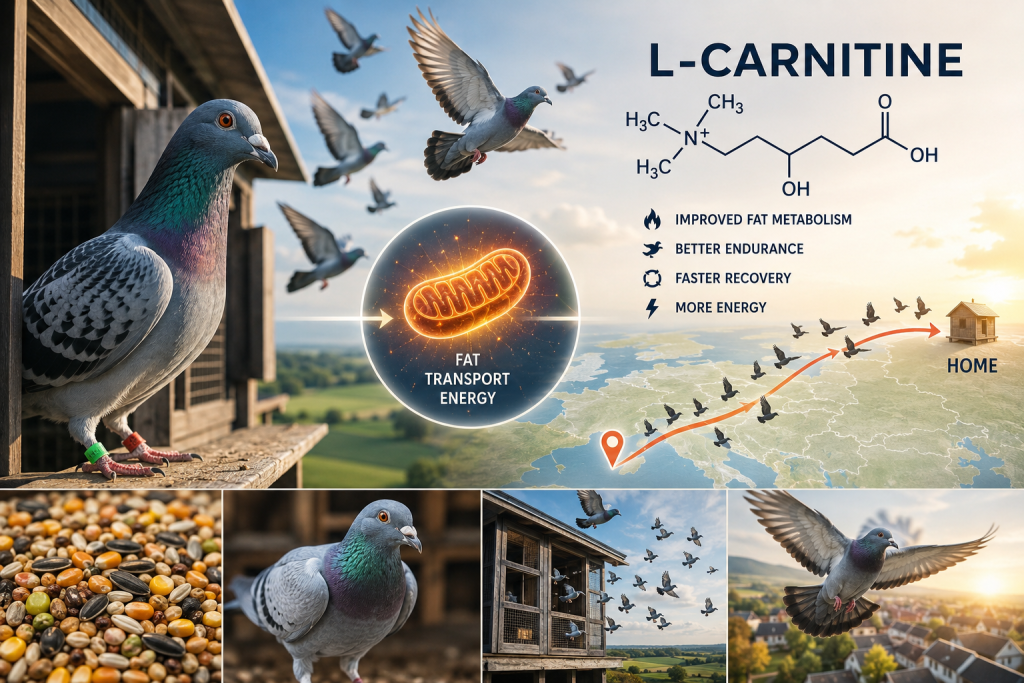
When used as part of a proper conditioning program, L-carnitine can significantly improve endurance. Pigeons are able to access and utilize their energy reserves more efficiently, allowing them to sustain prolonged periods of flight with less fatigue. Many fanciers also notice that birds receiving L-carnitine recover faster after races and training sessions. Instead of remaining exhausted for extended periods, they often regain their vitality more quickly and are ready for the next challenge sooner.
One of the reasons L-carnitine has become so popular is its ability to help pigeons achieve a lean, athletic condition. Birds often develop tighter muscles, a smoother feather quality, and a more refined body shape. However, this is where many fanciers can make a costly mistake. There is an important difference between a pigeon that is fit and a pigeon that is simply too thin.
Because L-carnitine enhances the utilization of fats for energy, birds can gradually burn through their reserves if their nutritional intake is not adjusted accordingly. A pigeon may appear exceptionally light and athletic, leading the fancier to believe it is in perfect condition, while in reality it may be lacking the energy stores required for peak performance. This situation is particularly common when birds are maintained on light depurative mixtures for too long while receiving supplements designed to increase fat metabolism.
A racing pigeon should not be judged solely by its weight. The ideal racing pigeon is one that combines fitness with sufficient energy reserves. During competition, especially in middle-distance, long-distance, and marathon events, the bird depends on stored fats as its primary fuel source. If these reserves are insufficient, the pigeon may begin the race in excellent condition but struggle to maintain its pace during the later stages of the journey. In such cases, a bird that appears perfectly prepared in the basket may lack the fuel necessary to finish strongly.
This is why feeding management becomes critically important when using L-carnitine. The supplement does not create energy on its own; it simply helps the body utilize available fats more effectively. To maximize the benefits of carnitine, pigeons must receive adequate sources of dietary energy, particularly during the days leading up to a race. High-quality fats and energy-rich grains provide the raw materials that L-carnitine can convert into sustained performance.
Seeds and grains such as peanuts, hemp, safflower, sunflower hearts, flaxseed, rapeseed, maize, and milo can play an important role in maintaining proper energy levels. These ingredients help build the reserves necessary for demanding flights and ensure that birds do not become excessively lean during the racing season. Rather than fearing dietary fats, successful fanciers understand that these nutrients are essential components of endurance racing when provided in appropriate amounts.
The balance between conditioning and feeding becomes even more important as race distances increase. In sprint races, pigeons rely more heavily on carbohydrates and explosive power. As race distances become longer, however, fat metabolism becomes increasingly important. This is where L-carnitine can truly demonstrate its value, helping birds efficiently utilize their energy reserves throughout the journey. Nevertheless, the greater the emphasis on fat metabolism, the more important it becomes to ensure that adequate reserves are available before basketing.
Experienced fanciers often learn to recognize the warning signs of a pigeon that has become too lean. A pronounced breastbone, loss of muscle volume, reduced vitality, or difficulty recovering after exercise may indicate that the bird is burning more energy than it is receiving through nutrition. In these situations, increasing the energy density of the feed is often more beneficial than increasing training intensity.
When incorporated into a well-balanced racing program, Top Form from Cest Pharma can be a valuable ally in developing superior athletic condition. The 100 mg of L-carnitine helps optimize energy metabolism, supports endurance, and contributes to faster recovery. However, the greatest results are achieved when supplementation is combined with intelligent feeding practices that provide adequate fats and energy-rich nutrients. Ultimately, the goal of every racing pigeon fancier should not be to produce the lightest pigeon in the loft. The goal is to produce a pigeon that is fit, muscular, healthy, and fully equipped with the energy reserves needed to perform at its highest level. L-carnitine can help unlock a bird’s athletic potential, but only when it is supported by proper nutrition. The most successful racing pigeons are not those that have burned away every reserve of fat; they are the birds that strike the perfect balance between fitness and fuel, allowing them to return home ahead of the competition.